
E-Commerce Website Design
Your store's job is to convert. A slow Shopify template is getting in the way. We build custom storefronts on Shopify's infrastructure — the speed of hand-coded, the reliability of a platform that processes billions of dollars in transactions.
You're paying for Shopify. You're not getting the most out of it.
Most Shopify stores score between 30 and 55 on PageSpeed. That's not a Shopify problem. It's a theme problem.
Shopify's default themes are built to work for every store on the platform. That means they carry features, scripts, and code that your store doesn't need. Every app you install adds more. The result is a storefront that looks fine on WiFi and falls apart on mobile with a 4G signal. Customers tap away before the product images finish loading.
Shopify's backend is genuinely good. Inventory, payments, fulfillment, subscriptions — that infrastructure is solid and worth paying for. What isn't worth paying for is the slow, bloated template sitting on top of it.
We use Shopify's Storefront API to keep the backend and replace the frontend entirely. Your customers get a custom site that loads in under a second. You keep every feature you're already paying for.
Shopify's backend. Our frontend. The best of both.
The Shopify Storefront API is Shopify's headless commerce layer. It lets us query your store data — products, collections, inventory, cart, checkout — from any frontend we write.
That means we write the HTML, CSS, and JavaScript ourselves, from scratch. No theme files. No Liquid templates. No third-party scripts loading in the background that you didn't ask for.
What your customers see: a fast, custom-designed storefront that loads in under a second and looks exactly like your brand. What runs behind it: Shopify handling payments, inventory, order management, fulfillment, and subscriptions. You don't lose anything. Your customers get a much better experience.
- Product catalog and inventory
- Orders and fulfillment
- Payments (Stripe, Shop Pay, Apple Pay)
- Subscriptions and recurring billing
- Customer accounts
- Discount codes and gift cards
API
- Hand-coded HTML, CSS, JavaScript
- Custom product page design
- Subscription builder UI
- Cart and checkout flow
- Brand-first visual design
- Sub-second load times
A slow store is a leaky bucket. Speed isn't a tech thing — it's a revenue thing.
Every e-commerce brand runs some version of this: you're getting traffic, you're spending on ads, and the conversion rate is stuck at 1–2%. You test the copy. You change the CTA button. You try new hero images. The needle barely moves.
The variable most owners haven't tested is load time.
Google's own data shows 53% of mobile visitors leave a site that takes more than 3 seconds to load. That's not people bouncing because your product isn't right for them. Those are customers who already clicked through, already interested, already about to buy — and your store loaded slowly so they hit back.
If your store converts at 2% and a 1-second speed improvement gets you to 2.14%, that's a 7% revenue increase on every order — without spending another dollar on ads.
of mobile visitors leave a site that takes more than 3 seconds to load
Google / SOASTA, Think with Googleconversion drop for every additional 1-second delay in page load time
Akamai, Online Retail Performance Reportof e-commerce traffic comes from mobile devices — where slow sites hurt most
Statista, E-commerce Device Share 2024Shopify Storefront API, fully custom, or a theme? Here's what we actually recommend.
The honest answer depends on what you're selling and where you are in your business. Most clients end up on the Storefront API path. Some need something fully custom. A few would genuinely be better off with a theme agency — and we'll tell you that too.
Shopify + Custom Frontend
You want Shopify's backend — inventory, subscriptions, payments, fulfillment — and a storefront that's actually fast and on-brand. We keep Shopify, replace the theme entirely, and query everything through the Storefront API.
- Right for established Shopify stores or new builds
- Subscriptions, complex inventory, multi-channel
- Custom design, sub-second load times, 90+ PageSpeed
- Timeline: 3–4 weeks from design approval
- Starting at $300/mo
Fully Custom
Simpler catalog, no subscriptions, or specific checkout requirements that Shopify can't accommodate. We build the whole thing from scratch with Stripe or Square for payments.
- Right for stores with under 20 SKUs or specific flows
- Full control over every transaction and pixel
- Custom design, same speed standards
- Timeline: 4–6 weeks
- Starting at $300/mo
Theme-Based Shopify
We don't install themes. We don't reskin templates. If you need a theme-built store, there are good Shopify agencies for that. Custom takes longer and costs more upfront — but the site doesn't look like 200,000 others.
- We'll refer you to theme agencies if it's the right fit
- Honest about what makes sense for your situation
- This card exists so you know before you call
The things template stores fake. Ours actually do them.
A product page is a sales conversation. Every element either moves someone toward buying or gives them a reason to leave. Here's what we build into every e-commerce site — not as a checklist, but as a set of decisions about how stores actually convert.
Product pages built around the moment of decision
The product page is where most stores lose customers. Long load times, tiny images, confusing variant selectors, no urgency. We design around the specific question a customer asks at that moment: "Is this right for me, and can I trust these people?" That means high-quality images, clear variant selection, real reviews, and a path to checkout that doesn't require three forms and a prayer.
Subscription commerce, built properly
Recurring revenue is the best thing that can happen to an e-commerce brand. We build custom subscription flows — frequency selectors, skip, pause, and cancel controls, reactivation sequences — that don't depend on a monthly Recharge bill on top of your Shopify bill. Clean, fast, yours. Green Shades Coffee's entire subscription model runs on the custom flow we built.
Cart and checkout you control
Template stores add apps for cart drawers, upsells, and custom checkout experiences — and every one adds latency. We build cart interactions into the frontend itself. The checkout stays on Shopify's infrastructure (PCI compliant, battle-tested), but everything up to that point is ours. No app overhead, no conflicting scripts.
Mobile-first, not mobile-compatible
70% of your traffic is on a phone. "Mobile-responsive" means the desktop site collapsed into a phone shape. Mobile-first means we designed it for a thumb and a 4G connection and worked outward from there. Those aren't the same thing — and you can tell the difference in your bounce rate.
Email capture that works
Newsletter signups, abandoned cart flows, and post-purchase sequences are where most brands leave money. We integrate with Klaviyo, Mailchimp, or whatever you use — built into the site itself, not bolted on with a third-party widget adding 200ms to your load time.
Speed as a permanent feature
PageSpeed scores decay over time as apps get added, images get uploaded uncompressed, and code drifts. Because we own the codebase and handle ongoing maintenance at $300/mo, speed is something we actively keep up — not a number you hit at launch and never check again.
Stores We've Built
Two live e-commerce stores, both powered by the Shopify Storefront API on a custom frontend. Both fast. Both brand-specific. Neither looks like a Shopify template.

Green Shades Coffee Co.
Green Shades is a purpose-driven coffee brand that donates a portion of every sale to animal shelters. When they came to us they had a product people loved and a Shopify store that didn't reflect it. We rebuilt the entire frontend on the Storefront API — custom subscription builder, product catalog with variants, and a site that leads with the mission. The checkout still runs on Shopify. The subscriptions still run through Shopify. Everything the customer sees is custom code.
- Shopify Storefront API integration
- Custom subscription builder (frequency, product mix, pause/cancel)
- Product catalog with variant selection
- 90+ PageSpeed score on mobile
- Shop Pay and Stripe checkout
- Klaviyo newsletter integration
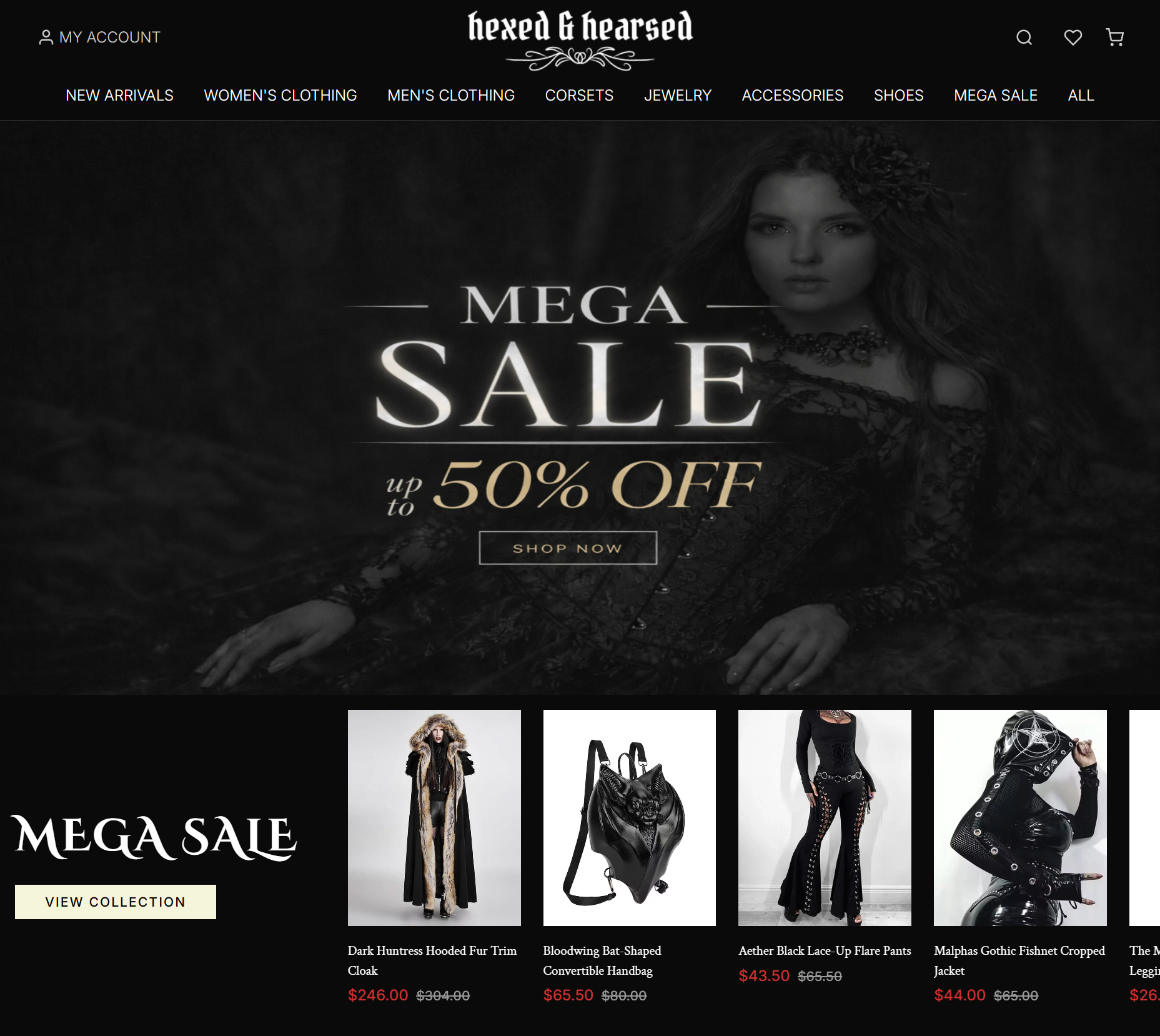
Hexed & Hearsed
Hexed & Hearsed sells gothic and alternative clothing to a customer who can tell the difference between a brand that cares about aesthetics and one that slapped a logo on a Shopify theme. The design is dark, intentional, and immediately on-brand. The shopping experience — category browsing, size and color selection, mobile checkout — is fast and frictionless. This wasn't a theme reskin. The visual identity required a fully custom approach, and the build reflects that.
- Dark-themed, fully custom design
- Product catalog with size and color variants
- Category navigation and collection pages
- Mobile-optimized product gallery
- Atmospheric brand storytelling throughout
- Secure payment processing
90+
PageSpeed score on every store we ship
<1s
Load time on mobile, real-world conditions
100%
Custom code — no theme files, no Liquid
$300
Per month including hosting and maintenance
How It Works
E-commerce builds take a little longer than a brochure site — there's more to set up, more to test, more to get right before launch. Here's what the process looks like.
Discovery call
30 minutes. We talk about your products, your platform situation, what you're selling, and what your current store's problems are. We'll tell you whether Shopify Storefront API is the right fit or whether a fully custom build makes more sense for your situation.
Design and API setup
We design the frontend and configure your Shopify store — products, collections, payment methods, shipping, subscriptions if applicable. You get one design draft to review and give feedback on before we start building.
Frontend build
We write the HTML, CSS, and JavaScript. We connect everything to the Storefront API. We test on real devices — phones, tablets, slow connections — not just a Chrome inspector. Most stores are ready for final review within 2–3 weeks of design approval.
Launch and ongoing maintenance
We launch, submit to Google Search Console, and connect your analytics. Hosting, security, backups, and up to 2 content changes per month are included in your $300/mo. Product updates, new collections, and catalog changes you handle directly in your Shopify admin.
Common Questions
Do I need an existing Shopify account to work with you?
No. If you have one, we work with it. If you don't, we set one up as part of the project. The right Shopify plan depends on your sales volume and features — we'll point you to the right tier. For most small brands launching for the first time, the Basic plan covers everything you need.
What's the difference between your approach and a Shopify theme?
A theme is a pre-built set of templates that anyone can install. They're designed to work for every kind of store, which means they carry features and code yours doesn't need. We write the frontend from scratch using the Shopify Storefront API. No theme files, no Liquid template inheritance, no third-party theme code loading in the background. The result is a site that loads faster, looks more distinctive, and doesn't share its DNA with hundreds of other stores.
Can you migrate my existing Shopify store to a custom frontend?
Yes. Your products, orders, customer records, and subscription data stay in Shopify. We replace only the frontend — what customers see and interact with. There's no migration of backend data. Your store stays live while we build the new frontend, and we do a clean switchover at launch.
What does $300/mo cover for an e-commerce site?
Hosting, SSL, security, backups, and up to 2 content changes per month — banner updates, new product collections added to navigation, homepage copy updates. Product management (adding products, editing descriptions, changing prices) you handle directly in your Shopify admin. Major redesigns or new features are quoted separately. See the full breakdown on our pricing page.
Do you handle product photography?
No — we design around the photography you have. Better product photography almost always has more impact on conversion than any design change. If your photos are weak, we'll tell you before we start, not after. We can point you toward photographers we trust if that would help.
Explore more
Our custom web design team builds fast storefronts for every industry. Pair with local SEO when you're ready to grow organic traffic. View pricing or get in touch.
Other services we build — all hand-coded, all fast.
Philadelphia Web Design Contractor Websites Venue Websites Startup Products View PricingYour store should be working harder than it is.
If it's slow, generic, or losing you somewhere in the funnel, that's a fixable problem. Let's talk about what a custom Storefront API build would look like for your brand.
Book a Free Call